
Trump said that the prize announced by the Nobel committee was for 2024, while he resolved these wars in 2025.
India has strongly rejected a UN expert's report claiming that Myanmar refugees in India faced pressure after the Pahalgam terror attack, calling the analysis biased and unfounded.
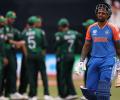
'Engaging with Pakistan at this stage sends out a message that undermines the sentiments of the people of India who stand firmly against any compromise on national security.'

Pakistan team manager Naveed Akram Cheema lodged a "formal protest" against match referee Andy Pycroft alleging that he asked both captains not to shake hands during the toss.

The brief exchange and handshake between Jaishankar and Sharif took place at a banquet dinner hosted by the Pakistani prime minister at his residence in honour of the delegates attending a summit of the Shanghai Cooperation Organisation.

BCCI secretary Devajit Saikia said that an invitation has been extended to chiefs of all three Armed forces, top-ranked officers and soldiers for the IPL 2025 final on June 3.

US President Donald Trump claims India has significantly reduced and nearly stopped purchasing oil from Russia, citing de-escalation efforts. This follows previous tensions over tariffs and India's energy sourcing.
India succeeded in busting the Pakistani narrative on Operation Sindoor, particularly among the Organisation of Islamic Conference (OIC) member nations, where Islamabad sought succour after carrying out terror activities across the border, Shiv Sena leader Shrikant Shinde said.
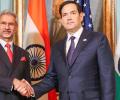
The phone conversation came amid escalating tensions between India and Pakistan over the April 22 terror attack that killed 26 civilians.
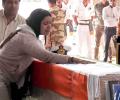
'Operation Sindoor is still ongoing. The Prime Minister himself said that blood and water cannot flow together, that talks and terrorism cannot go together. So how can we have a cricket match with a country that indulges in terrorism?'
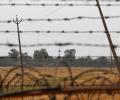
The United States on Thursday said it supports India's right to defend itself and its fight against terrorism as US Defence Secretary Pete Hegseth dialled Defence Minister Rajnath Singh amid rising tensions between India and Pakistan over the Pahalgam terror attack.

Amid a storm surrounding his collaboration with Pakistani actress Hania Aamir, singer-actor Diljit Dosanjh has taken to social media with a cryptic message.
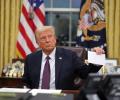
US President Donald Trump claimed India will stop buying oil from Russia, while also stating China will cut back substantially. He also discussed the conflict between India and Pakistan, reiterating his claim of helping settle the conflict.
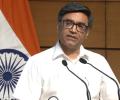
India carried out missile strikes on terror targets in Pakistan and Pakistan-Occupied Kashmir, including the Jaish-e-Mohammad stronghold of Bahawalpur and Lashkar-e-Taiba's base in Muridke, after the Pahalgam attack that killed 26 civilians. The Foreign Secretary said the actions were measured, non-escalatory, proportionate and responsible.

Dar recalled that when he met US Secretary of State Marco Rubio in July and asked about dialogue with India, the top US diplomat clarified that India has maintained it is a "bilateral issue."
US President Donald Trump has repeated his claim of "stopping" the conflict between India and Pakistan through trade and tariffs, and suggested he deserves the Nobel Peace Prize for settling multiple conflicts.
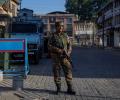
India has reached out to Denmark and other non-permanent members of the UN Security Council to apprise them of the Pahalgam terror attack and its cross-border linkages. External Affairs Minister S Jaishankar has spoken to his counterparts from several nations, conveying India's resolve to bring the perpetrators to justice. The outreach comes as India mulls options for responding to the attack, with Prime Minister Modi assuring the harshest response for the "perpetrators and conspirators." India has also received condolences and condemnations from world leaders, including US President Donald Trump and French President Emmanuel Macron.

United States President Donald Trump on Monday praised India and Prime Minister Narendra Modi without naming him, saying 'India is a great country with a good friend of mine at the top'.
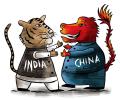
India and China have announced a series of measures aimed at improving their relationship, including maintaining peace along the border, reopening border trade, and resuming direct flights.

India and Pakistan have managed to "break the ice" on the Asia Cup trophy dispute and will work towards finding a plausible solution in the coming days, BCCI secretary Devajit Saikia said.

India rejected Pak's proposal to hold FS-level talks on Kashmir.
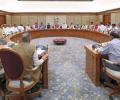
The meeting under the chairmanship of Prime Minister Narendra Modi has been convened at 11 am on Wednesday.
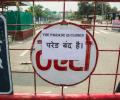
Pakistan's Foreign Minister Ishaq Dar has called for a 'composite dialogue' with India to address the contentious issues between the two sides.

Poonch district alone accounted for 13 civilian deaths among 28 fatalities in the Pakistani shelling and drone attacks in Jammu and Kashmir after the Indian armed forces carried out missile strikes on terror infrastructure across the border under Operation Sindoor in May in retaliation to the April 22 Pahalgam terror attack that left 26 persons, mostly tourists, dead.
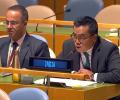
India also slammed Pakistan Prime Minister Shehbaz Sharif for raking up Jammu and Kashmir at the UN.
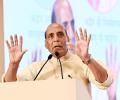
Defence Minister Rajnath Singh on Sunday said it is his responsibility to work with the armed forces and give a "befitting reply" to those who cast an evil eye on India, his remarks coming in the backdrop of the recent Pahalgam terror attack. Singh's assertion came as India is mulling retaliatory measures against Pakistan in view of the cross-border linkages to the April 22 Pahalgam terror attack that has killed 26 people, mostly tourists. He said, "As the defence minister, it is my responsibility to work with my soldiers and ensure the protection of the country's borders. And it is my responsibility to give a befitting reply, by working with the armed forces, to those who cast an evil eye on our country."

Just as Gandhiji's spinning wheel became a symbol of resistance, Indian travellers today can turn their passports into instruments of peaceful protest, argues Harsh Roongta.

Writing in the United Kingdom's 'Financial Times' newspaper on Tuesday, the minister sought to counter criticism over Prime Minister Narendra Modi-led government's announcement over the "anachronistic provision" last month, which he said had resulted in socio-economic injustice due to the inability to apply national laws in Jammu and Kashmir.
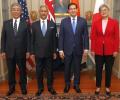
The Quad grouping has called for bringing the perpetrators, organisers and financiers of the Pahalgam terror attack to justice without any delay and urged UN member nations to extend cooperation for it.

The demand for action by Pakistan was made through a joint statement issued after the 2+2 ministerial attended by the US Secretary of State Antony Blinken and Defence Secretary Lloyd Austin, Defence Minister Rajnath Singh and External Affairs Minister S Jaishankar.
'With the US having entered the war, raising the risks of a wider conflict, those impacts could be even more damaging.'
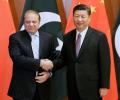
His remarks came in response to the India-US joint statement issued after the talks between Prime Minister Narendra Modi and US President Donald Trump.

Rejecting Pakistan's efforts to define terrorism in any particular way, New Delhi underlined that everyone knows what the scourge constitutes and that it was important to end it.
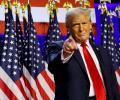
The White House has criticized the Nobel Peace Prize Committee for allegedly overlooking President Donald Trump's contributions to global peace, citing his efforts in brokering deals and resolving conflicts.

In his address at the meeting of the foreign ministers of the Shanghai Cooperation Organisation in Benaulim, Goa, Jaishankar said the channel of finances for terror activities must be blocked without any distinction even as Bhutto Zardari raised the issue of "violation of international law" which was seen as an apparent reference to Kashmir.

Tensions between India and Pakistan are escalating following last week's dastardly terror attack in Pahalgam that claimed 26 lives.
The Congress Working Committee (CWC) condemned the Pahalgam terror attack, calling it a direct assault on the values of the republic. The party accused the BJP of exploiting the tragedy to promote discord and polarization, while urging for unity and solidarity in the face of adversity. The CWC also demanded a comprehensive analysis of the intelligence failures and security lapses that led to the attack.
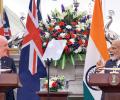
India and New Zealand have signed a pact to institutionalize their defence ties and vowed to boost cooperation in the Indo-Pacific. Prime Minister Narendra Modi raised concerns about anti-India activities by some illegal elements in New Zealand with his Kiwi counterpart Christopher Luxon. The two sides also signed six agreements to enhance cooperation in areas including education, sports, agriculture, and climate change. They also agreed to prepare a roadmap for cooperation in the defence industry sector and explore early implementation of cooperation in the digital payments sector.

Defence Minister Rajnath Singh on Saturday asserted that India would not hesitate to act against terrorists who target the country from across the border.
